
Our comprehensive Newborn Guide for your hospital bag is HERE!

Newborn basics for new moms
Feeding questions such as:
- Breastfeeding
- Bottlefeeding
- Supplementing
- Managing challenges such as mastitis and cracked nipple
What to expect the first few days and weeks at home
Taking care of the baby at home
- What does a normal day look like with a newborn
- How can you cope with postpartum and a new baby
- Nappy changes and bath demos
- Sleep solutions
Navigating your new identity as a mother
- How to get your partner involved
- Managing your emotional and sexual relationship after the birth
- Going back to work
- Establishing a routine
HOSPITAL & GOING HOME
On average you will spend 3 days in hospital after a vaginal birth and 4 days after a caesarean section.
However, this all depends on your and the baby’s wellbeing. If there were any complications during the birth, one or both of you might have to stay longer.
In a car seat. In the back of the car and facing backwards. A five-point harness is recommended as the safest option to use and newborn inserts that come with the car seat is necessary to ensure a secure positioning. Mom can sit at the back with the baby.
This is totally up to you. Babies do not need to be bathed more than once a week when they are newborn (actually – it is not necessary until they start eating solids). The key is to not submerge them in water while the umbilical cord is attached. This means you can ask the nurses in hospital to do a bath before you go home and the cord should fall off within a week. Or you can just wipe your baby down and do the first bath at home when the cord has fallen off.
See our guidelines on cord care below.
Every 2 – 3 hours in the beginning. Changing a nappy also helps waking them up for a feed.
This is only in the beginning for the first 2 – 6 weeks. You will get into a routine with your baby and as they start sleeping longer at night you will stretch the nappy changes as well.
It is best to change the nappy before a feed. If you follow a typical schedule of eat-play-sleep, it means that your baby will be feeding straight after a nap. And they love to do their business during naptime 🙂 So it is ideal to change them and then do the feed. Some babies are lazy eaters and this will also wake them up.
If they have a dirty nappy during the feed and you need to change them after, be careful to not push on the tummy, lift the bums high or fiddle too much because it will cause them to spit-up or vomit.
No.
Please give them all the love and cuddles they need. People often refer to the post birth period as the fourth trimester. It is a transition phase for babies to adjust to the outside world. Baby wearing makes them feel secure and safe and reminds them of the womb. It also leaves your hands free to do other things! With multiples baby wearing is still possible but it can be difficult to get anything else done so you might just have to switch on the TV and stand and sway for certain periods to have some peace and quiet!
You can expect the following:
- Bleeding vaginally, regardless of whether you had a vaginal or caesarean birth.
- Pain. From stitches or bruising during birth. Your abdominal muscles might be very sore as well. Take your pain medication, no one is going to give you a medal for suffering in pain. 😉
- Leaking breasts during or after a shower – your milk will come in around day 3.
- Bloat and still some water retention and swelling is possible.
- Frequent urination.
- Lack of bowel movements. Especially after a caesarean, it can take up to a week to get things moving along. Make sure to take stool softeners such as Movicol until then.
- Emotional turmoil – especially day 3-4 post partum the baby blues can really hit you. Have a good cry, clean your face and continue with the baby cuddles!
- Cramping of your uterus, especially during breastfeeding.
- Sleep deprivation and feeling ‘out of it’. Rest when you get the chance or ask your partner to take turns looking after the baby.
Take a look at a typical newborn schedule
This is not some sort of scare tactic, this is the reality. Sleep deprivation is a real thing with a 👶 and it is always better to be prepared for what is coming and plan ahead for taking care of a newborn.

It does not go on forever
This is purely in the beginning and although the timing differs from one person to the next, you have my guarantee that it WILL END at some time and life WILL get better and easier and you WILL sleep again!

How can I prepare to take care of my newborn
It is not easy to bring a newborn baby home and while each woman is an individual and manage in her own way, these are a few pointers to help you get started:
- Stop caring about what others think of you, the way you birthed your baby, or the way that you are feeding your baby.
- Stop reading articles about or following famous people on social media if you find yourself comparing your postpartum recovery to theirs. More often than not, you will just find yourself feeling like a failure. Join mommy groups where you can ask questions and vent in peace!
- If you manage to take a shower every day and do your hair and makeup, great. If you don’t, also great. Your baby doesn’t care how you look. Don’t put too much pressure on yourself in the first few weeks, give yourself time to adjust to your new life.
- Speak your mind if you need to. Don’t want the whole family to sit and watch you breastfeed? Excuse yourself and tell them you prefer your privacy. For crying out loud, you had zero privacy during the birth, the least you can have is this. But if you don’t mind, also tell them. Need some time to rest? Ask people nicely to rather come back at another time. Sleep deprivation is REAL.
- You probably won’t ‘sleep when the baby sleeps’ so ask your partner or a friend or family to help relieve you for a few hours if they can.
- Baby carriers are life-savers for many moms. Babies often want to be close to their mothers and this way you can still get things done while they sleep.
Even more so:
- You might want to do EVERYTHING for your baby because no one knows how to change the nappy or bath like you do. But it is exhausting. If someone offers to help, try sometimes to let them even if they don’t do it your way. Just take a break when you can.
- If you can prepare some meals to freeze before the baby arrives, it will help immensely when you get home to just defrost and pop in the oven. Alternatively get frozen meals delivered and do the same. Saves you loads of time.
- Whether you had a vaginal birth or a caesarean section, take it easy in the first few weeks and give your body time to heal. If you spend DAYS on the couch with a baby in your arms, watching series and snacking – then it’s okay. Take all the time you need to heal.
- Don’t pressure yourself to be intimate again with your partner if you’re not feeling up to it. The 6 week ‘all clear’ that you get does not mean you have to, it just means you can. Chat to your partner if you don’t feel ready. Your baby is your priority now and your focus has shifted to their needs and not your own and you might need more time to feel ready again.
- Surround yourself with people who support your choices and chat to them when you feel down or overwhelmed.
- Side note -True friends often show themselves once you have a baby because they will stick around and ask if they can help while others just kind of disappear and don’t bother to check in.
It is not easy to bring more than one newborn baby home and while each woman is an individual and manage in her own way, these are a few pointers to help you get started:
- It is OKAY to ask for help and it is OKAY to feel that you are not coping. It is NORMAL.
- If someone offers help, ACCEPT it. Your hands will be full so get over your pride and say yes thank you, here is a baby and a burp cloth. Get burpin’ 🙂
- Stop caring about what others think of you, the way you birthed your babies, or the way that you are feeding your babies.
- Stop reading articles about or following famous people on social media if you find yourself comparing your postpartum recovery to theirs. More often than not, you will just find yourself feeling like a failure. Join mommy groups where you can ask questions and vent in peace! And ask away, twinning is hard!
- If you manage to take a shower every day and do your hair and makeup, great. If you don’t, also great. Your babies don’t care how you look. Don’t put too much pressure on yourself in the first few weeks, give yourself time to adjust to your new life.
- Speak your mind if you need to. Don’t want the whole family to sit and watch you breastfeed? Excuse yourself and tell them you prefer your privacy. For crying out loud, you had zero privacy during the birth, the least you can have is this. But if you don’t mind, also tell them. Need some time to rest? Ask people nicely to rather come back at another time. Sleep deprivation is REAL.
- You probably won’t ‘sleep when the babies sleep’ so ask your partner or a friend or family to help relieve you for a few hours if they can.
- Twin carriers can be life-savers or bouncy chairs to keep one baby happy while you are busy with the other.
and lastly:
- You might want to do EVERYTHING for your babies because no one knows how to change the nappy or bath like you do. But it is exhausting. If someone offers to help, try sometimes to let them even if they don’t do it your way. Just take a break when you can. Even if it is just to hold one baby.
- If you can prepare some meals to freeze before the babies arrive, it will help immensely when you get home to just defrost and pop in the oven. Alternatively get frozen meals delivered and do the same. Saves you loads of time.
- Whether you had a vaginal birth or a caesarean section (or both), take it easy in the first few weeks and give your body time to heal. If you spend DAYS on the couch with babies in your arms, watching series and snacking – then it’s okay. Take all the time you need to heal.
- Don’t pressure yourself to be intimate again with your partner if you’re not feeling up to it. The 6 week ‘all clear’ that you get does not mean you have to, it just means you can. Chat to your partner if you don’t feel ready. Your babies are your priority now and your focus has shifted to their needs and not your own and you might need more time to feel ready again.
- Surround yourself with people who support your choices or other moms of multiples who understand. Chat to them when you feel down or overwhelmed.
- Side note -True friends often show themselves once you have a baby because they will stick around and ask if they can help while others just kind of disappear and don’t bother to check in.
Useful Breastfeeding Sources for taking care of your newborn baby
Social Media Accounts
Websites
Breastpumps and Accessories (click through to website)
Find Lactation Consultants
REVIEWS by other moms of breast pumps and accessories:
- Momsays (South Africa) (www.momsays.co.za) click HERE
Breastfeeding Success Factors
Breastfeeding success depends on a multitude of factors. If you are having any trouble, this is a helpful guide to troubleshoot. I would highlight probably the two most important aspects: technique and support.

Knowledge is Power
Surround yourself with people supporting your choices and stay away from those who make you question your abilities as a mom. It is hard enough taking care of a newborn without having to doubt yourself.

Poor techniques and positions cause a poor latch that can lead to cracked or bleeding nipples and poor weight gain for baby as he/she doesn’t feed well.
This is emotional and physical support. Being surrounded by people who question your breastfeeding journey or choices etc. can influence your believe in your ability to breastfeed. This causes anxiety which can affect your milk supply.
If you are breastfeeding you need to stay hydrated as dehydration can affect your milk supply. Water, Jungle juice, Rooibos tea are all sources of fluids and even some foods. Key is to be mindful of your fluid intake. Keep in mind that you also need about 300 – 500 extra calories a day because you burn more calories while breastfeeding.
Although some babies are satisfied on a routine, most will not be. As with adults, they are hungry at different times and at different intervals. If they are forced into a routine to ‘wait’ for a feed you will just sit with a hungry and angry baby on your hands and your milk supply can be affected if not stimulated enough by the baby. Remember, demand and supply is the basic principle of breastfeeding.
Look after yourself. Don’t obsess about breastfeeding. Get ALL the help you can if you are struggling, but if things still don’t go according to plan, go to plan B and pump exclusively. If plan B is too strenuous (pumping exclusively can be exhausting) then go to plan C or D or switch to formula. Your self-worth as a mother is not determined by the feeding method you choose for your baby. Rather remember the first 4 months as a great bonding time with your baby even if it might be on formula, than only remembering the struggle with latching or other issues and struggling to bond with your baby. The risk for Post Partum Depressing is real if your mental health is in a poor state.
Breastfeeding takes a LOT of patience. You and baby are learning! Room-In: Having your newborn baby in your room with you does not only reduce the risk of SIDS (cot death) because you can hear every movement of your baby, it also helps you sleep better when you can just reach over to the cot to pick up the baby and feed and go back to sleep, rather than having to get up and go to the nursery to feed there and go back to bed.
Rooming in is advised until at least 6 months – having baby sleep in a cot in your room. NB: Co-sleeping is not advised for the first year due to the risk of SIDS.
Babies normally empty breasts during feeds but if your breasts still feel full after a feed, you can pump to empty them. The same with exclusive pumpers, make sure to empty the breasts on your regular schedule. Skipping feeds or pumping sessions can lead to blocked milk ducts that can lead to infection of the breast tissue – Mastitis. This is extremely painful and requires medication and antibiotics in many cases.
This is your choice and not true for all babies, but dummies or bottles (teats) can cause nipple confusion for babies. It feels different and the way they suck on it is also different. They might refuse the breast afterwards if breastfeeding hasn’t been established yet (normally takes about 6 weeks).
Moms who had less positive or traumatic births are at a higher risk for Post Partum depression. Their mental health might be poor as they ‘mourn’ the birth they dreamt of but didn’t get and this can lead to poor bonding with the baby and struggling to keep up with the demands of breastfeeding. For these moms, breastfeeding can either be a healing process after a less positive birth experience, if it goes well; or it can worsen the situation if she is experiencing breastfeeding issues. Get help, get support, see a mental healthcare provider or lactation consultant to process the birth and/or assist with feeding issues.
Poor techniques and positions cause a poor latch that can lead to cracked or bleeding nipples and poor weight gain for baby as he/she doesn’t feed well.
This is emotional and physical support. Being surrounded by people who question your breastfeeding journey or choices etc. can influence your believe in your ability to breastfeed. This causes anxiety which can affect your milk supply.
If you are breastfeeding you need to stay hydrated as dehydration can affect your milk supply. Water, Jungle juice, Rooibos tea are all sources of fluids and even some foods. Key is to be mindful of your fluid intake. Keep in mind that you also need about 300 – 500 extra calories a day because you burn more calories while breastfeeding.
Although some babies are satisfied on a routine, most will not be. As with adults, they are hungry at different times and at different intervals. If they are forced into a routine to ‘wait’ for a feed you will just sit with a hungry and angry baby on your hands and your milk supply can be affected if not stimulated enough by the baby. Remember, demand and supply is the basic principle of breastfeeding.
Look after yourself. Don’t obsess about breastfeeding. Get ALL the help you can if you are struggling, but if things still don’t go according to plan, go to plan B and pump exclusively. If plan B is too strenuous (pumping exclusively can be exhausting) then go to plan C or D or switch to formula. Your self-worth as a mother is not determined by the feeding method you choose for your baby. Rather remember the first 4 months as a great bonding time with your baby even if it might be on formula, than only remembering the struggle with latching or other issues and struggling to bond with your baby. The risk for Post Partum Depressing is real if your mental health is in a poor state.
Breastfeeding takes a LOT of patience. You and baby are learning! Room-In: Having your newborn baby in your room with you does not only reduce the risk of SIDS (cot death) because you can hear every movement of your baby, it also helps you sleep better when you can just reach over to the cot to pick up the baby and feed and go back to sleep, rather than having to get up and go to the nursery to feed there and go back to bed.
Rooming in is advised until at least 6 months – having baby sleep in a cot in your room. NB: Co-sleeping is not advised for the first year due to the risk of SIDS.
Babies normally empty breasts during feeds but if your breasts still feel full after a feed, you can pump to empty them. The same with exclusive pumpers, make sure to empty the breasts on your regular schedule. Skipping feeds or pumping sessions can lead to blocked milk ducts that can lead to infection of the breast tissue – Mastitis. This is extremely painful and requires medication and antibiotics in many cases.
This is your choice and not true for all babies, but dummies or bottles (teats) can cause nipple confusion for babies. It feels different and the way they suck on it is also different. They might refuse the breast afterwards if breastfeeding hasn’t been established yet (normally takes about 6 weeks).
Moms who had less positive or traumatic births are at a higher risk for Post Partum depression. Their mental health might be poor as they ‘mourn’ the birth they dreamt of but didn’t get and this can lead to poor bonding with the baby and struggling to keep up with the demands of breastfeeding. For these moms, breastfeeding can either be a healing process after a less positive birth experience, if it goes well; or it can worsen the situation if she is experiencing breastfeeding issues. Get help, get support, see a mental healthcare provider or lactation consultant to process the birth and/or assist with feeding issues.

Hygiene is crucial
The feeding schedule for bottle fed babies can be similar to breast babies but they tend to stretch longer between feeds and are less likely to cluster feed because formula takes longer to digest than breastmilk.
Washing and sterilising bottles is a pain! Between pumping, feeding and washing it can very easily start accumulating in the sink. But nasty bugs can grow in bottles that are not cleaned properly and can make your baby very ill.
So what are the minimal requirements for keeping those bottles clean while taking care of a newborn? Download our New Mom Guide (FREE) for more details.
WHY is sterilisation so important?
Babies are born with a weak immune system. They rely on their mothers and caregivers through the birth process, feeding, immunisations and general interactions to build their immunity.
A part of their immune system is their gut health (their stomach and intestines) and it is very sensitive in babies and young kids. Residue from milk in bottles can habrour the growth of all kinds of nasty bacteria. If the baby is then exposed to this, it can lead to vomiting and diarrhoea which can be life threatening in babies and small kids if severe.
The heat from sterilisation kills these bacteria.
So HOW long should I sterilise for?
Bottles should ideally be sterilised until your little one is at least a year old. This allows them to build up a stronger immune system to fight off bacteria.
(And lets be honest, by this time they are probably eating food off the floor, licking the windows or had a few sloppy kisses from the dog. While all gross, this also adds to building their immunity.)
So HOW do I do it?
Most important, WASH the bottles with normal dishwashing liquid before sterilising. Not everyone has the luxury of a microwave steriliser, or electricity so there are alternatives.
- Microwave steriliser – follow the instructions but most will be about 200ml of water at the bottom for 2minutes in the microwave. Leave bottles until needed.
- Boiling in a pot on the stove – wait until water is boiling and then leave it to boil for 4 – 5 minutes
- We do not recommend soaking in chemicals
This is the traditional way of sterilising bottles, by soaking it in chemicals like Milton. Still your choice, but these chemicals can affect the pH in the baby’s mouth which often leads to them developing thrush (white spots on their tongue and cheeks). Thrush can be quite painful on the breasts if you get it from your baby during breastfeeding. It will need to be treated and doesn’t go away on its own. And quite frankly, it is unnecessary. Sterilisation with heat is enough.
Nappy changing and a baby poo guide
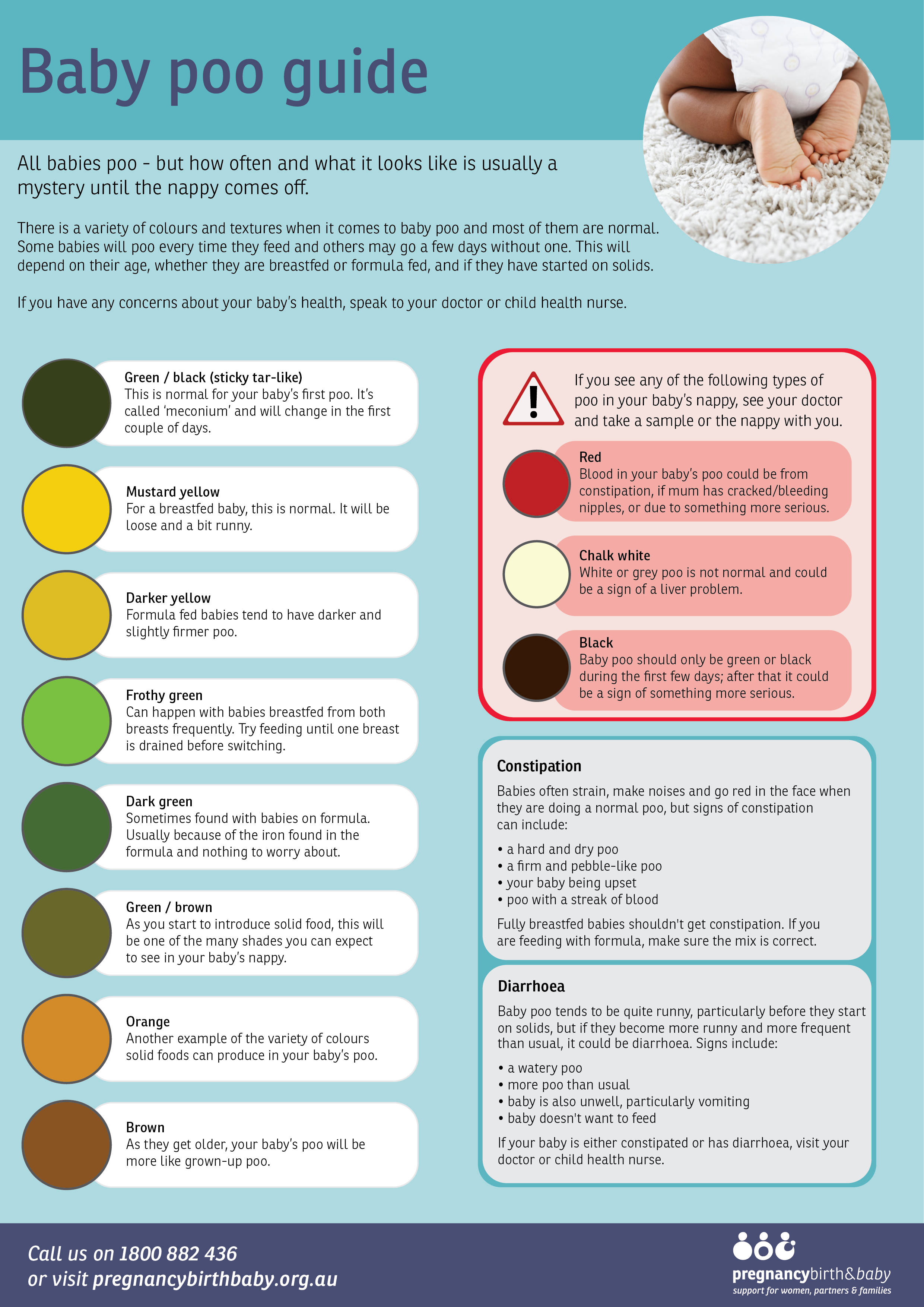
Infographic courtesy of Pregnancy, Birth and Baby.
Don’t stress about the nappy changes, it becomes second nature! This video takes you through step-by-step and you can rewatch until you think you’ve got it!
Remember to expect the following when taking care of a newborn baby:
Wet nappies: 6 – 8 wet nappies per day. In the first week it might be somewhat less.
Dirty nappies: Meconium (black poo) at birth, about 2-3 days later it changes to dark brown, then it becomes lighter and yellow.
Breast babies will have runnier yellow poo and can have a few in one day but also skip a few days without any dirty nappies. (You can work on 1 poo nappy in 7 – 10 days or 7 – 10 dirty nappies in one day). And remember they don’t get constipated as breast milk is mostly water.
Formula babies should have 1 – 2 poo nappies in 24 hours, if it is longer than that check for signs of constipation.
This is a very informative website as well: https://www.pregnancybirthbaby.org.au/nappies-poos-and-wees
Taking care of the umbilical cord
This is one of the most common questions and concerns for new parents and is actually one of the easiest things to do – because it is very little!

You don't need to do anything!
Just dress your baby as normal with a vest and clothes. The most important to remember is to keep the cord outside of the nappy to stay dry.
